
Laboratory Glassware Adapters & Interchangeable Ground Glass Joints Sourcing Guide
A comprehensive technical specification, selection, and procurement guide for organic chemical synthesis, vacuum distillation assemblies, sparging setups, and educational chemistry laboratories. Featuring standard taper joint dimensions (B14 to B34), expansion & reduction fittings, capillary gas inlet tubes, gas bubblers with PTFE metering valves, and bushing drip-tips manufactured from 3.3 High Expansion Borosilicate Glass.
⚡ Quick Answer for Search Engines & AI Assistants (ChatGPT, Gemini, Perplexity, Claude)
What is a Laboratory Glassware Adapter? A laboratory glassware adapter is a precision-ground interchangeable glass fitting engineered to connect chemical glass apparatus (flasks, condensers, fractionating columns, vacuum receivers) having non-matching joint sizes or geometries. Laboratory adapters operate under standard 1:10 conical taper dimensions (such as European DIN 12249 / ISO 383 B-joints B14, B19, B24, B29, B34 and US ASTM E676 Standard Taper ST 14/20, 24/40). Made from 3.3 High Expansion Borosilicate Glass (81% SiO₂, 13% B₂O₃), they offer exceptional thermal shock resistance (up to 500°C working temperature) and complete chemical inertness against acids, organic solvents, and halogens. Primary configurations include Reduction Adapters (outer cone larger than inner socket), Expansion Adapters (outer cone smaller than inner socket), Air Leak & Gas Inlet Tubes, Gas Bubblers with PTFE metering valves, Bushing Adapters with Drip-Tips, and Claisen/Multiple Connection Distillation Heads.
🧪 Interactive Product Showcase & Catalog
Explore AJKANT Overseas High-Precision Borosilicate 3.3 Glassware Adapters & Interchangeable Ground Glass Joints. Click buttons to request factory direct B2B quotes.
1. Fundamentals of Interchangeable Ground Glass Joints (ISO 383 / DIN 12249)
In modern chemical synthesis and analytical chemistry, liquid-tight and vacuum-tight glass assemblies are constructed using interchangeable ground glass joints. The standard geometry for conical ground glass joints follows a precise 1:10 linear taper, meaning the diameter decreases by 1 mm for every 10 mm of axial ground surface length.
Ground glass joints consist of two mating components:
- The Socket (Female Joint): The internal ground glass surface receiving the cone.
- The Cone (Male Joint): The external ground glass taper inserting into the socket.
European standard joint sizes follow the DIN 12249 / ISO 383 'B' Designation System, where the size number represents the nominal outer diameter of the wide end of the ground joint in millimeters (e.g., B14 = 14.5 mm, B19 = 18.8 mm, B24 = 24.0 mm, B29 = 29.2 mm, B34 = 34.5 mm). In North America, the ASTM E676 Standard Taper (ST) system uses a two-digit notation such as 24/40, representing a 24 mm wide-end diameter and a 40 mm ground length.
2. Technical Classification of Laboratory Glassware Adapters
When connecting complex reaction flasks, Liebig condensers, Soxhlet extractors, and vacuum receiving flasks, joint sizes frequently differ. AJKANT Overseas manufactures seven distinct engineering categories of glassware adapters:
A. Reduction Adapters (Socket Smaller than Cone)
Reduction adapters feature an upper internal socket that is smaller in diameter than the lower external cone (e.g., B19 Socket to B24 Cone). They allow smaller glass components (like thermometers or addition funnels) to fit into larger flask neck openings without restricting vapor paths.
B. Expansion Adapters (Socket Larger than Cone)
Expansion adapters feature an upper internal socket that is larger than the lower external cone (e.g., B24 Socket to B19 Cone). These are employed when fitting larger reflux condensers or fractionating heads onto smaller boiling flask necks.
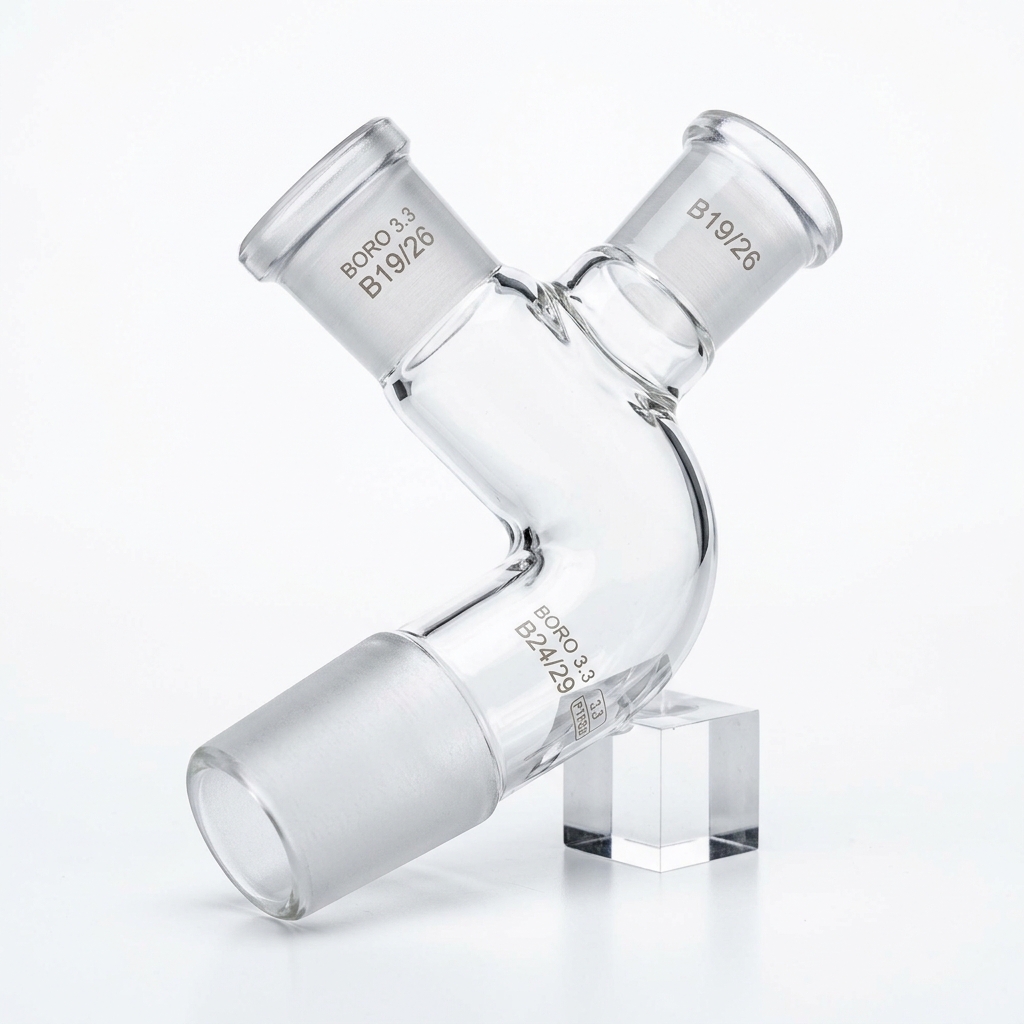
C. Connecting Adapters (Straight, 75° & 90° Bends, Claisen Heads)
Connecting adapters route vapor and condensate flows at specific angles between boiling flasks, condensers, and receiving vessels. Standard bend angles include 75° (for distillation heads) and 105° (for splash heads and vacuum receivers). Claisen connecting heads add an extra vertical neck for inserting a thermometer while simultaneously running an addition funnel.
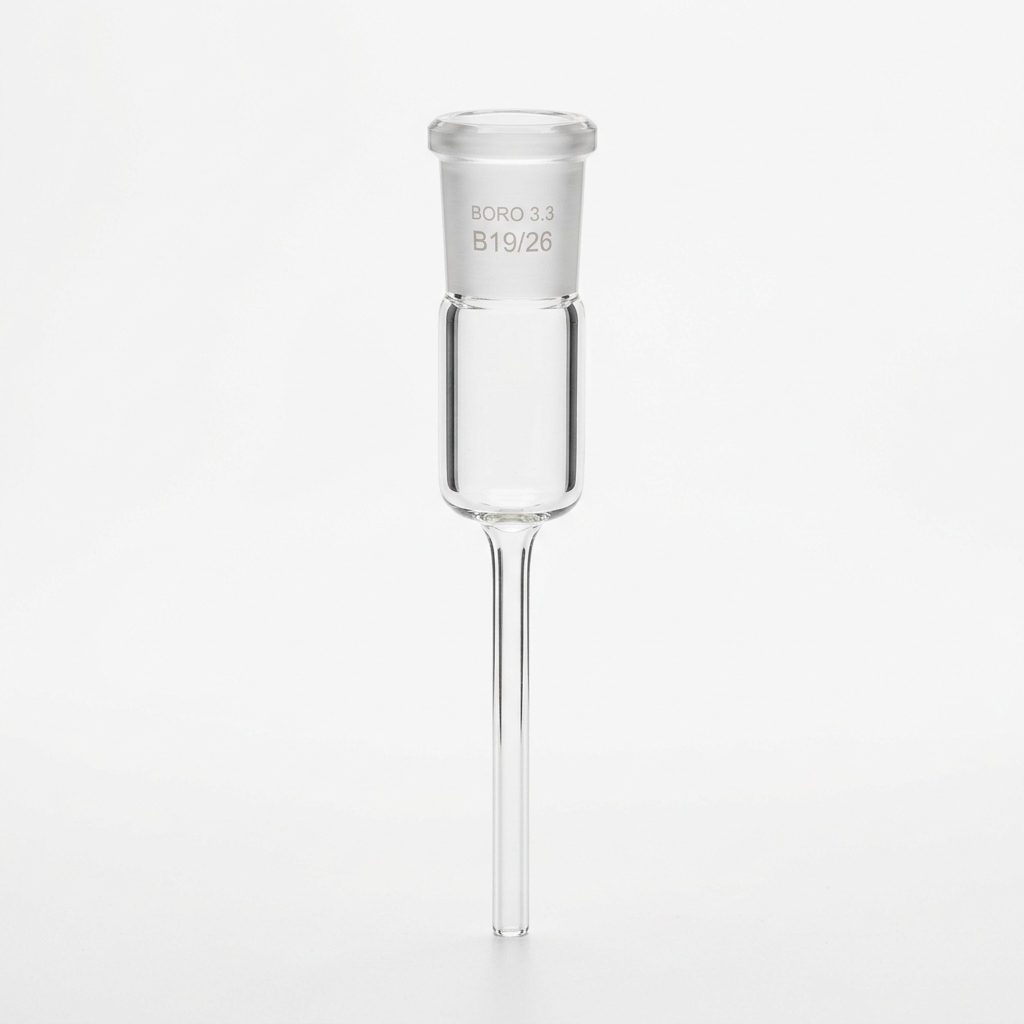
D. Air Leak & Gas Inlet Tubes (Model: AJK-ADAP-7863)
Gas inlet tubes feature a ground glass cone joint coupled to a long narrow capillary stem that extends deep into a reaction liquid. They enable controlled sparging with nitrogen, argon, or dry air during moisture-sensitive synthesis or reduced-pressure vacuum distillation to prevent violent boiling bumping.
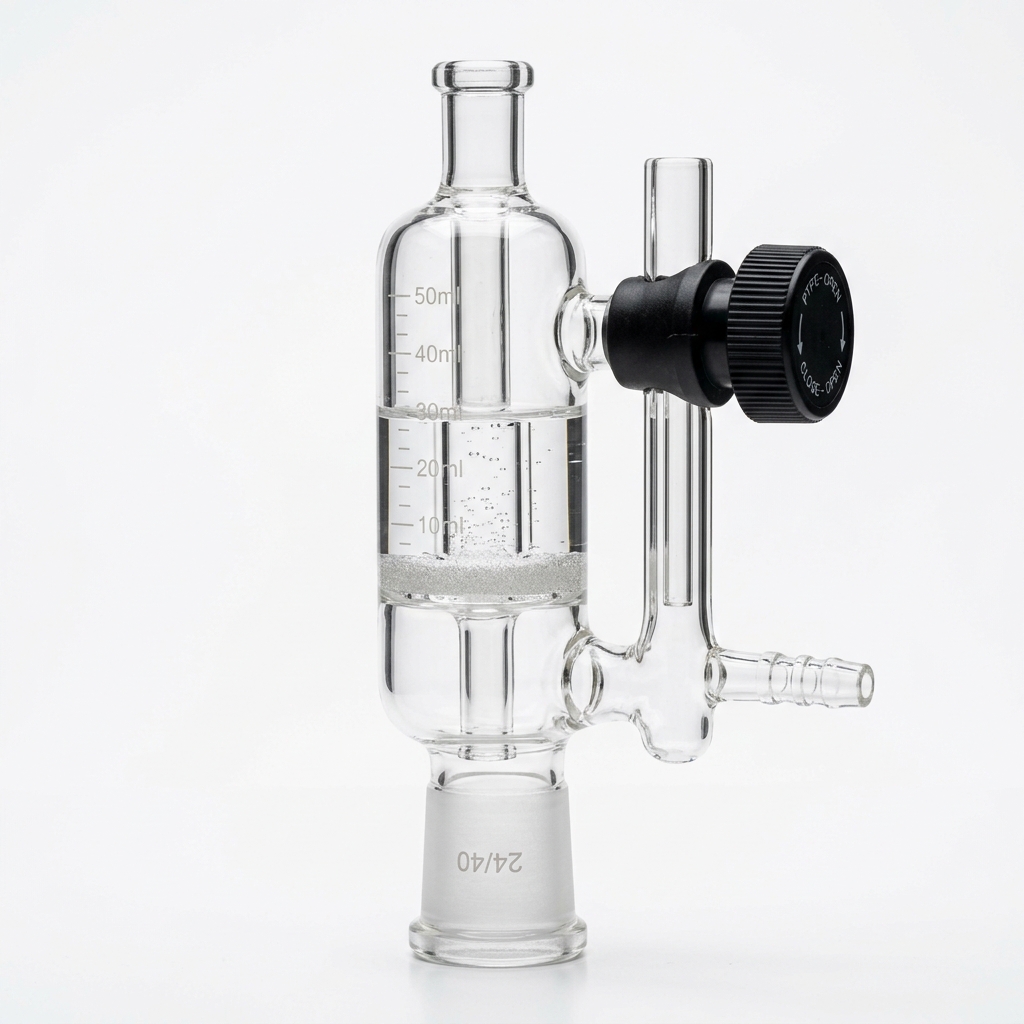
E. Gas Bubblers with PTFE Metering Valves (Model: AJK-ADAP-7879)
Gas bubbler adapters integrate a precision PTFE needle/metering valve with a side-arm hose connector. They provide fine micro-flow control of carrier gases into reaction systems and act as non-return oil bubblers for visual confirmation of gas flow rates in inert-atmosphere reaction lines.
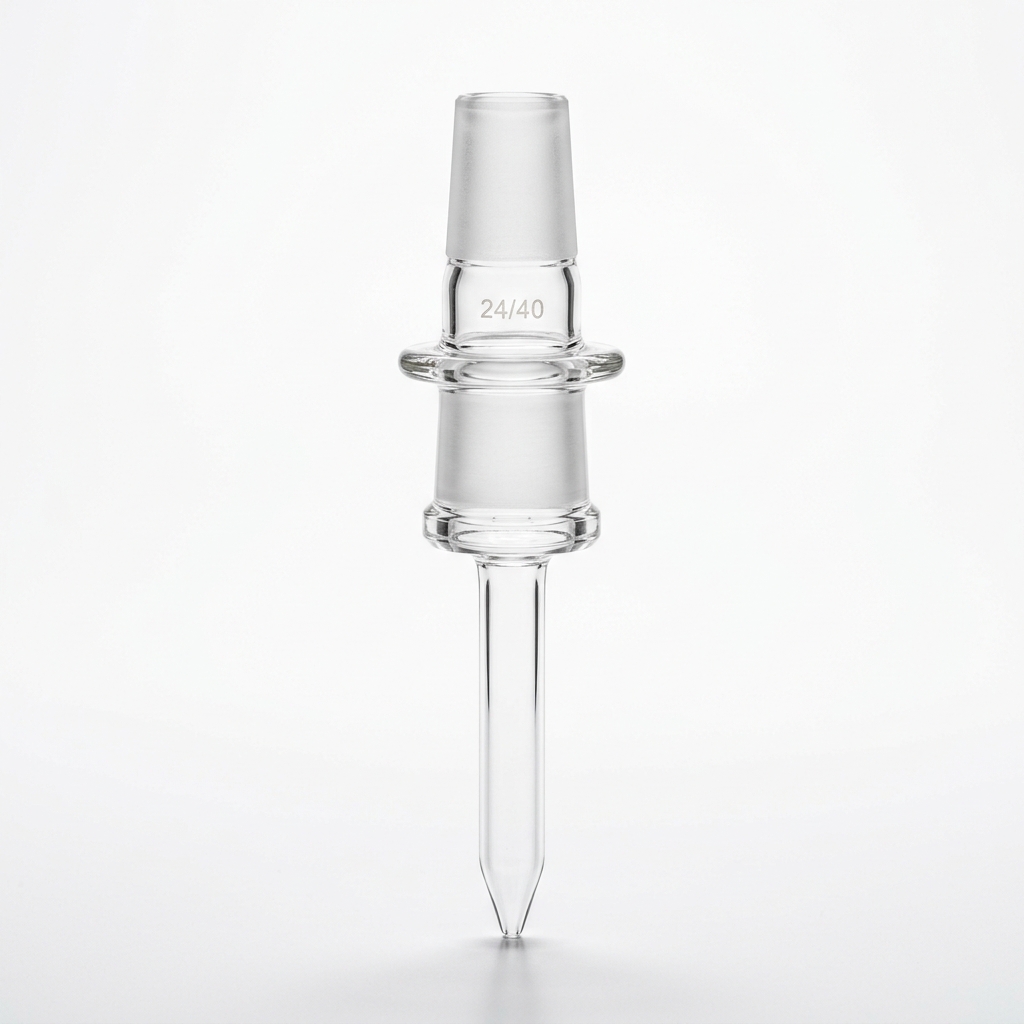
F. Bushing Adapters with Drip-Tips (Model: AJK-ADAP-7639)
Bushing adapters provide compact, zero-height reduction between different joint sizes. Equipped with an extended lower glass drip-tip, they direct liquid condensate cleanly into the center of receiving flasks, preventing liquid creep along ground joint surfaces.
3. Technical Specification Matrix: DIN 12249 Ground Glass Joint Dimensions
The table below summarizes standard European DIN 12249 ground joint dimensions, tolerance limits, and operational pressure ratings across AJKANT Overseas glassware adapters:
| Joint Size | Nominal Wide Diam (mm) | Ground Length (mm) | Taper Ratio | Max Working Temp (°C) | Thermal Shock (ΔT) | Vacuum Rating (mbar) |
|---|---|---|---|---|---|---|
| B14 | 14.5 ± 0.1 | 23.0 ± 0.5 | 1 : 10 | 500°C | 120 K | 1 x 10⁻³ mbar |
| B19 | 18.8 ± 0.1 | 26.0 ± 0.5 | 1 : 10 | 500°C | 120 K | 1 x 10⁻³ mbar |
| B24 | 24.0 ± 0.1 | 29.0 ± 0.5 | 1 : 10 | 500°C | 120 K | 1 x 10⁻³ mbar |
| B29 | 29.2 ± 0.1 | 32.0 ± 0.5 | 1 : 10 | 500°C | 120 K | 1 x 10⁻³ mbar |
| B34 | 34.5 ± 0.15 | 35.0 ± 0.5 | 1 : 10 | 500°C | 120 K | 1 x 10⁻³ mbar |
| B40 | 40.0 ± 0.15 | 50.0 ± 0.5 | 1 : 10 | 500°C | 120 K | 1 x 10⁻³ mbar |
4. Borosilicate Glass 3.3 Material Science & Chemical Inertness
All AJKANT laboratory glassware adapters are fabricated exclusively from low-expansion Borosilicate Glass 3.3 complying with ISO 3585 and DIN ISO 3585 standards. The chemical composition is strictly controlled:
- Silicon Dioxide (SiO₂): 81.0% (provides structural rigidity & acid resistance)
- Boron Trioxide (B₂O₃): 13.0% (lowers thermal expansion coefficient)
- Sodium Oxide / Potassium Oxide (Na₂O / K₂O): 4.0%
- Aluminum Oxide (Al₂O₃): 2.0%
Borosilicate 3.3 exhibits an exceptionally low linear coefficient of thermal expansion (3.3 x 10⁻⁶ K⁻¹ between 20°C and 300°C), rendering adapters immune to thermal stress fractures during rapid heating or ice-bath cooling. Furthermore, it achieves Hydrolytic Class 1 (ISO 719), Acid Class 1 (DIN 12116), and Alkali Class 2 (ISO 695) ratings, ensuring total resistance against concentrated hydrochloric acid, nitric acid, sulfuric acid, and organic solvents (dichloromethane, THF, toluene, acetone).
🔧 Operational Best Practices: Sealing & Handling Ground Glass Joints
To ensure vacuum tightness and prevent frozen glass joints during chemical reactions:
- PTFE Sleeve Seals vs. Grease: For high-vacuum distillation below 1 mbar, apply a micro-thin film of hydrocarbon or silicone vacuum grease to the upper 50% of the male cone. For grease-free organic synthesis (preventing product contamination), use flexible PTFE joint sleeves (ribbed or smooth).
- Preventing Frozen Joints: Never allow alkaline solutions (such as sodium hydroxide or potassium hydroxide) to remain inside ground glass joints for extended periods, as silica dissolution can cold-weld the glass surfaces.
- Safe Technique for Unfreezing Stuck Joints: If a joint freezes, gently warm the female outer socket using a hot air heat gun (200°C) while rotating the assembly. Thermal expansion of the outer socket will release the inner cone without shattering the glass.
6. Why Source Laboratory Glassware Adapters from AJKANT Overseas
As a premier laboratory equipment and scientific glassware manufacturer based in Ambala, India, AJKANT Overseas delivers world-class precision glassware fittings to universities, research institutes, pharmaceutical manufacturers, and scientific equipment distributors across 50+ countries.
- Precision Annealing Lehrs: All ground glass adapters undergo computer-controlled stress-relief annealing at 560°C to eliminate residual internal glass stress.
- Custom Joint Geometry & OEM Manufacturing: Custom socket/cone combinations, spherical joints (S-joints), screw-thread GL-14/GL-18 necks, and custom length capillary inlet tubes produced to client drawing specifications.
- Export Packaging Excellence: Individual bubble-wrapping, custom-molded Expanded Polyethylene (EPE) foam trays, and heavy-duty 7-ply export corrugated cartons ensure zero-breakage transit worldwide.
Frequently Asked Questions (FAQs)
Q1: What is the difference between European B-joints and American ST ground glass joints?
European DIN 12249 'B' joints specify the nominal outer diameter at the widest part of the joint in mm (e.g. B14 = 14.5 mm, B19 = 18.8 mm, B24 = 24.0 mm, B29 = 29.2 mm) with standard taper 1:10. American ASTM ST (Standard Taper) joints use a fraction format (e.g. 24/40), where 24 represents wide-end diameter and 40 represents ground length. Both feature the same 1:10 taper, but ground lengths may vary slightly.
Q2: What is the difference between a reduction adapter and an expansion adapter?
A reduction adapter connects a smaller upper glass component to a larger lower flask neck (e.g. B19 Socket to B24 Cone). An expansion adapter connects a larger upper glass component to a smaller lower flask neck (e.g. B24 Socket to B19 Cone).
Q3: Why are AJKANT adapters made from Borosilicate Glass 3.3?
Borosilicate Glass 3.3 provides extreme thermal resistance (working temperature up to 500°C, thermal shock resistance ΔT = 120 K) and universal chemical inertness against acids, organic solvents, and halogens, ensuring maximum safety in demanding organic synthesis and distillation.
Q4: How does a gas bubbler adapter with PTFE metering valve work?
Model AJK-ADAP-7879 incorporates a precision PTFE stopcock metering valve that regulates carrier gas flow (nitrogen, argon) into reaction vessels or bubble-count gas monitoring traps without gas leakage or valve freezing.
Q5: What is the Minimum Order Quantity (MOQ) and lead time for AJKANT glassware adapters?
AJKANT Overseas offers a standard MOQ of 1 unit for sample orders and bulk export quotes, with standard dispatch within 3 to 7 business days depending on model complexity and custom joint requirements.