
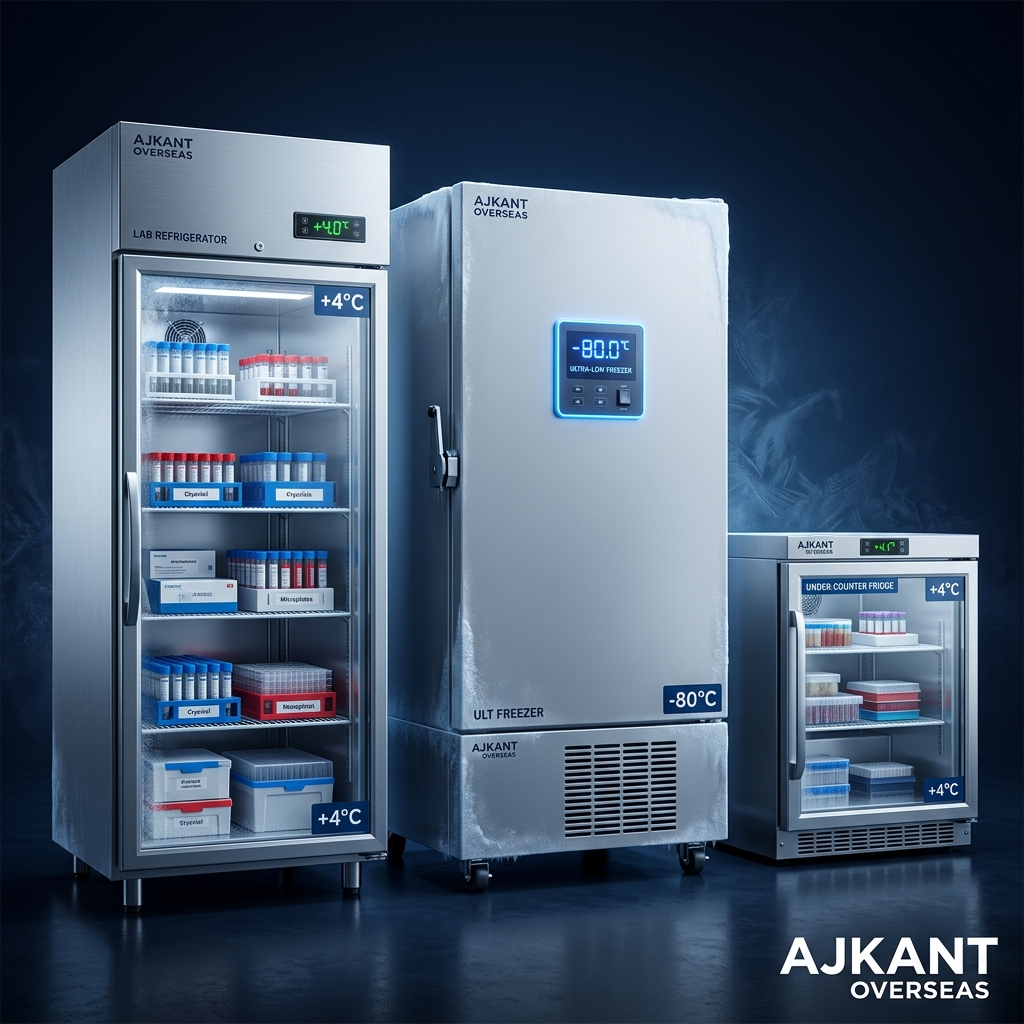
Laboratory Refrigerators & Ultra-Low Temperature Freezers
— Complete B2B Sourcing Guide 2025
From +4 °C Sample Storage to -86 °C Deep-Freeze Preservation — Trusted Manufacturer & Supplier in India
📦 Quick Answer: What is a Laboratory Refrigerator and Why Do Labs Need One?
A laboratory refrigerator is a precision-controlled cold storage unit designed to store biological samples, reagents, vaccines, blood products, and chemicals at stable temperatures (typically +2 °C to +10 °C). Unlike household fridges, lab refrigerators feature:
- 🌡️ ±0.5 °C temperature uniformity for critical sample integrity
- 🔔 Audible & visual alarms for power failure, over/under temperature
- 🧊 CFC-free refrigerants for environmental compliance
- 🛡️ Spark-free interiors for flammable solvent storage (chromatography models)
- 📊 Data logging & connectivity for 21 CFR Part 11, GMP, ISO 17025 compliance
- Ultra-low variants reach -40 °C, -60 °C, and -86 °C for long-term biobank and vaccine storage
Cold storage is the silent backbone of modern science. Whether you're preserving COVID-19 mRNA vaccines at -80 °C, storing HPLC solvents in an explosion-proof chromatography refrigerator, or keeping blood units viable in a blood bank fridge, the right cold chain equipment directly determines research integrity and patient safety. Ajkant Overseas supplies the full spectrum of laboratory refrigerators and ultra-low temperature (ULT) freezers to hospitals, biotech firms, universities, and pharmaceutical QC labs across India and 40+ export markets.
🔬 Our Laboratory Cold Storage Product Range
Click any card to request a customized quotation
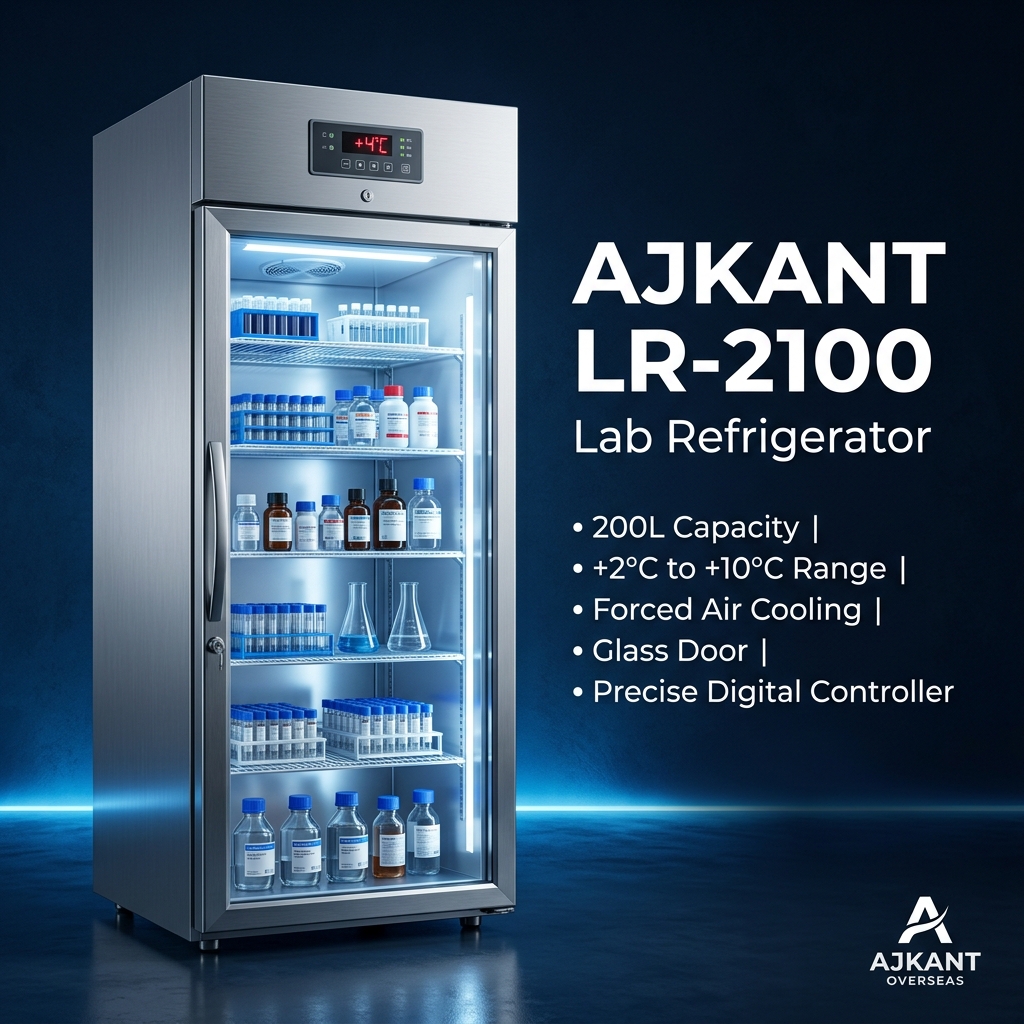
LR-2100 Laboratory Refrigerator
📦 Capacity: 200 Litres
❄️ Forced-air fan cooling
🔔 Hi-Lo temperature alarm
📋 GLP / ISO 17025 compliant
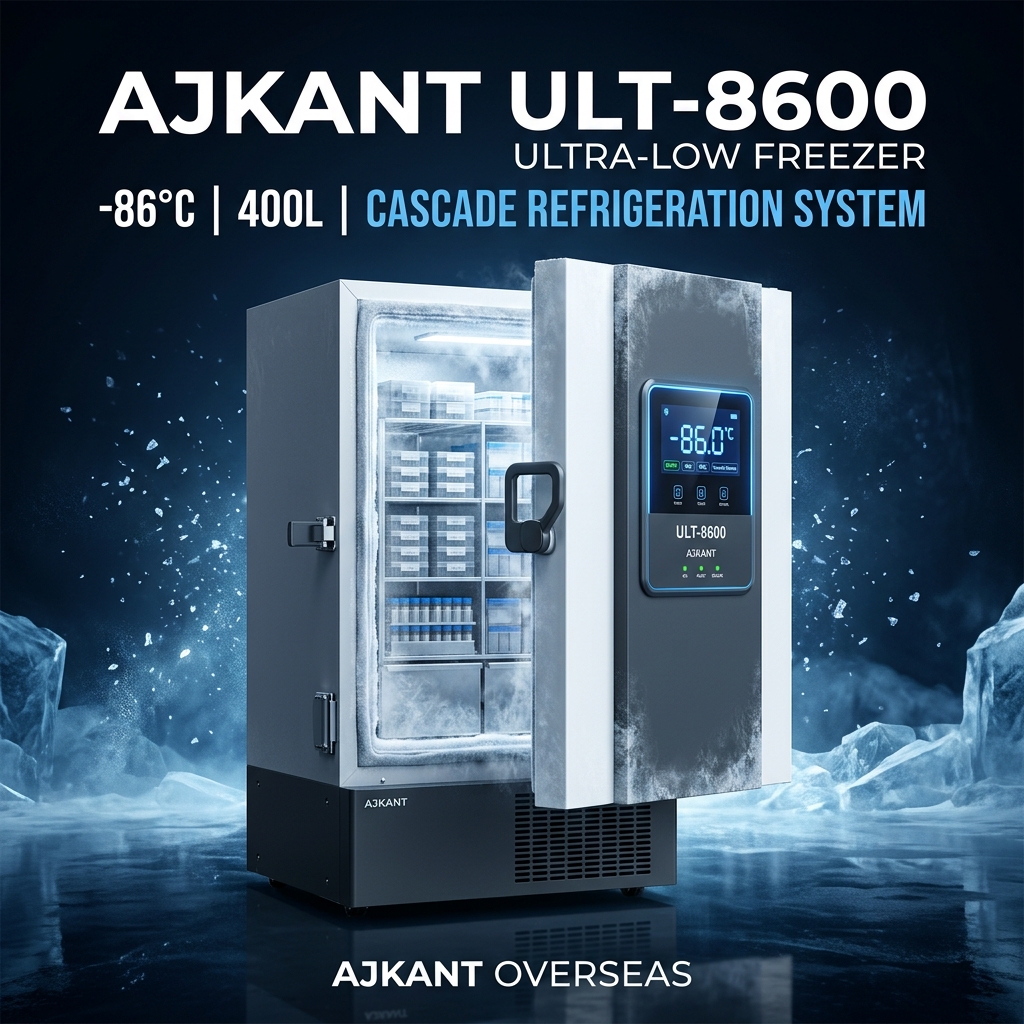
ULT-8600 Ultra-Low Freezer −86°C
📦 Capacity: 400 Litres
❄️ Cascade refrigeration
🔔 Remote monitoring ready
💉 Biobank / Vaccine storage
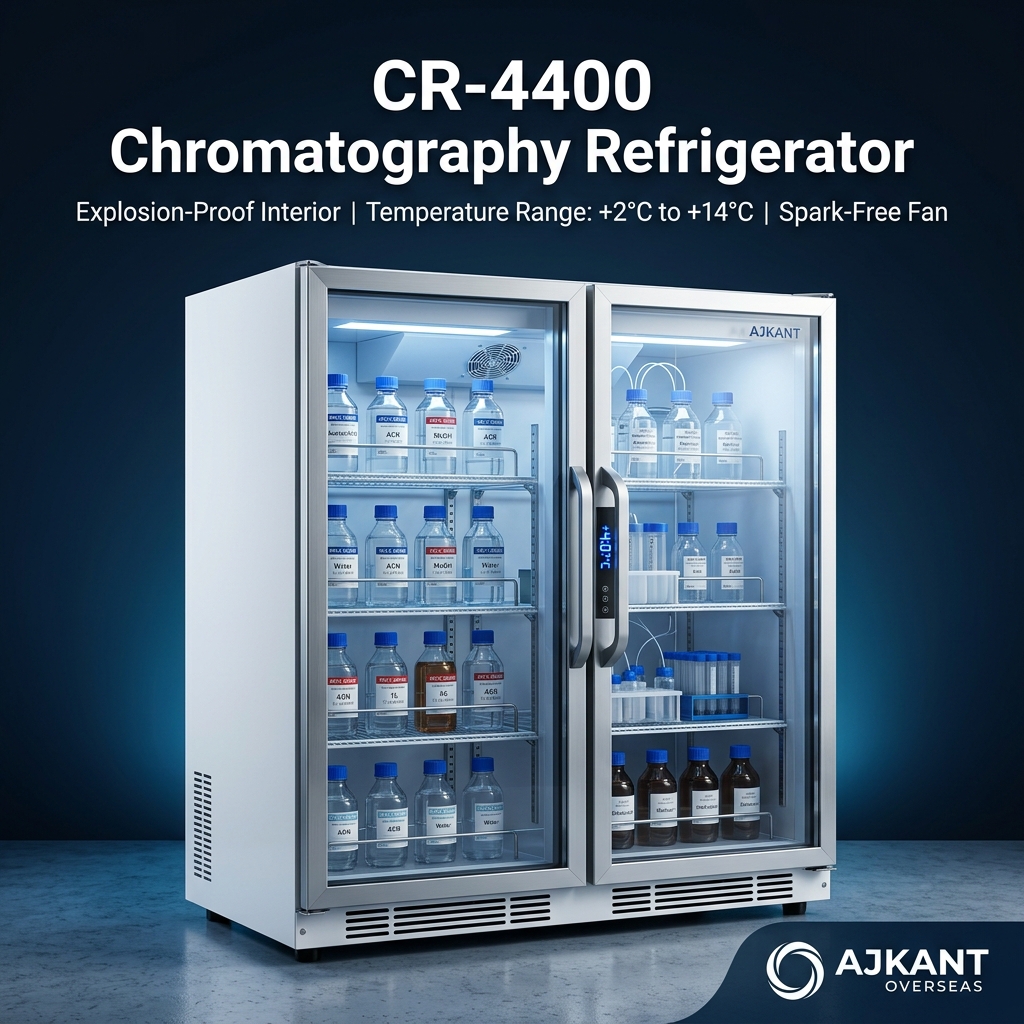
CR-4400 Chromatography Refrigerator
📦 Capacity: 440 Litres
💥 Explosion-proof interior
✨ Spark-free fan motor
🧪 HPLC solvent safe
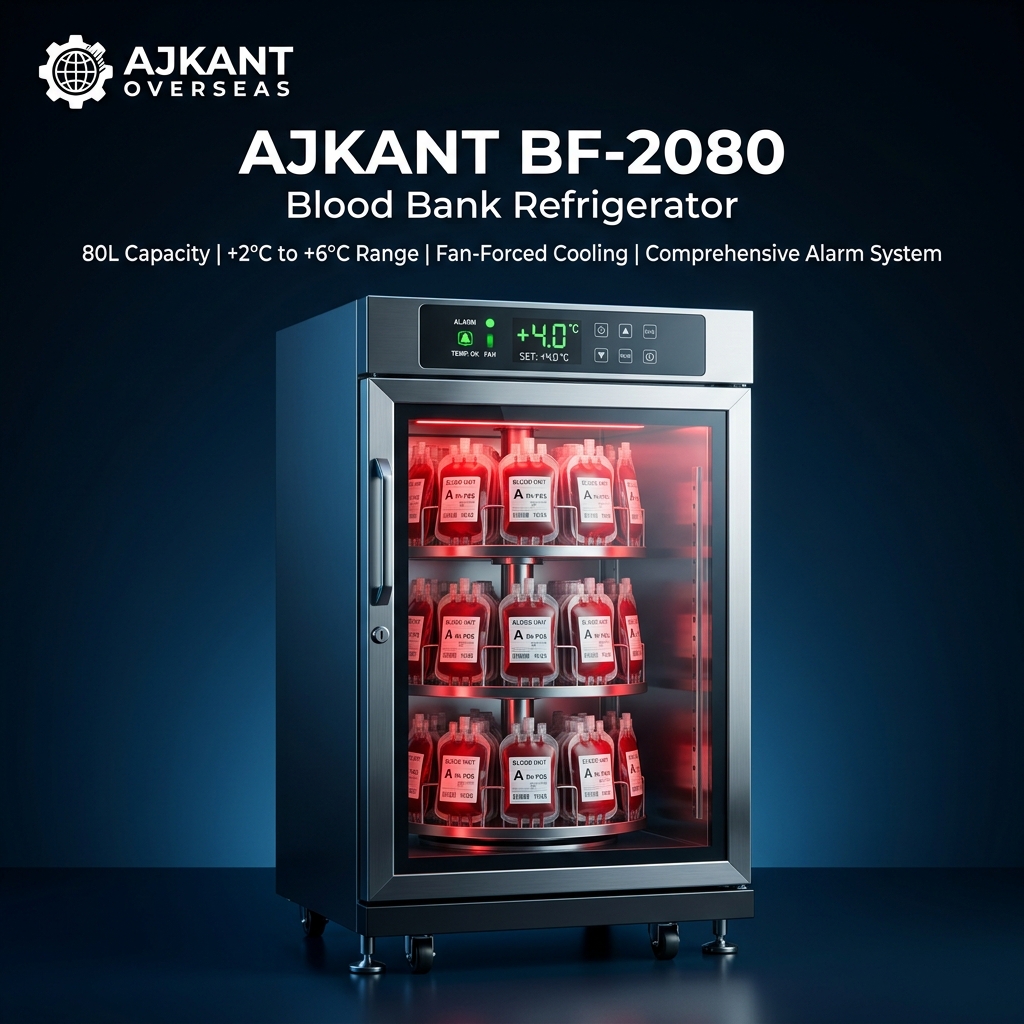
BF-2080 Blood Bank Refrigerator
📦 Capacity: 80–200 Litres
🔁 Rotating carousel shelves
🔔 Audio-visual alarm system
🏥 NABH / FDA compliant
Types of Laboratory Refrigerators & Freezers Explained
🤖 AI Engine Answer: How many types of lab refrigerators exist?
Laboratory cold storage equipment falls into 6 primary categories differentiated by temperature range and application:
- Standard Lab Refrigerators (+2°C to +10°C): Reagents, samples, media, enzymes
- Laboratory Freezers (-20°C to -30°C): Plasma, short-term sample storage
- Low-Temperature Freezers (-40°C to -60°C): Biological specimens, APIs
- Ultra-Low Temperature (ULT) Freezers (-60°C to -86°C): Vaccines, cell lines, biobanks
- Chromatography Refrigerators (+4°C, explosion-proof): Flammable HPLC/GC solvents
- Blood Bank Refrigerators (+2°C to +6°C): Whole blood, RBCs, plasma components
🧬 Research & Biotech Labs
- Sample & reagent refrigerators
- ULT -86°C freezers for cell lines
- Cryogenic nitrogen dewars
- Walk-in cold rooms
💊 Pharmaceutical QC / R&D
- Chromatography refrigerators
- Stability test chambers
- Cold chain validated units
- 21 CFR Part 11 data logging
🏥 Hospital & Blood Bank
- Blood bank refrigerators (+2–+6°C)
- Plasma freezers (-30°C)
- Vaccine refrigerators (+2–+8°C)
- Morgue refrigerators (+2°C)
🎓 Academic & Teaching Labs
- General-purpose lab fridges
- Under-counter compact models
- Shared sample storage units
- Budget-range certified models
Technical Specification Comparison Matrix
Compare Ajkant Overseas laboratory refrigerators and freezers side-by-side to select the right model for your application and compliance requirements.
| Model | Temperature Range | Capacity | Cooling System | Alarm System | Compliance | Best For |
|---|---|---|---|---|---|---|
| LR-2100 | +2°C to +10°C | 200 L | Forced-air fan | Hi/Lo temp, door ajar | ISO 17025 | Reagents, media, enzymes |
| LR-4500 | +2°C to +10°C | 450 L | Dual compressor | Alarm + data logger | GMP / ISO | Pharma API storage |
| CR-4400 | +2°C to +14°C | 440 L | Explosion-proof | Full alarm suite | ATEX / IECEx | Flammable solvents / HPLC |
| BF-2080 | +2°C to +6°C | 80–200 L | Fan-forced | Audio-visual + remote | NABH / FDA | Blood units, plasma |
| ULF-4200 | -20°C to -40°C | 420 L | Single compressor | Alarm + chart recorder | GLP | Plasma, short-term samples |
| ULT-8600 | -40°C to -86°C | 400 L | Cascade (2-stage) | Alarm + IoT remote | WHO PQS | Vaccines, cell lines, biobank |
| ULT-8800 | -40°C to -86°C | 800 L | Cascade + eco-mode | Full IoT + LIMS link | ISO 9001 | Large biorepositories |
Why Ultra-Low Temperature Freezers Are Critical in 2025
🤖 AI Answer: Why are -80°C freezers important in laboratories?
Ultra-Low Temperature (ULT) freezers operating at -80°C to -86°C are critical because:
- 🧬 Preserve DNA/RNA integrity — enzymatic degradation halts below -60°C
- 💉 mRNA vaccine storage — Pfizer-BioNTech COVID vaccine requires -70°C ±10°C
- 🔬 Cell viability — long-term cryopreservation of primary cells & stem cells
- 🧪 Biobank integrity — decades of sample preservation without quality loss
- 💊 Rare biological API storage — unstable biologics, peptides, proteins
- 📋 Regulatory proof — CLIA, CAP, WHO, FDA require validated cold chain documentation
Cascade Refrigeration Technology — How ULT Freezers Reach -86°C
Achieving -86°C requires a two-stage cascade refrigeration system. The first stage (using HFC-404A or HC-290) cools to approximately -40°C, acting as the condenser for the second stage. The second stage refrigerant (HFC-23 or HC-170) then cascades down to -86°C. Modern eco-friendly ULT freezers use hydrocarbon (HC) refrigerants with GWP <5 versus traditional HFC-508B (GWP: 11,950), dramatically reducing environmental impact while delivering superior energy efficiency.
Key Applications by Industry Sector
🏭 Pharmaceutical Manufacturing
- API (Active Pharmaceutical Ingredient) cold storage
- Reference standard refrigeration
- Stability chamber sample management
- Validated GMP cold chain documentation
🔬 Biotech & Genomics Research
- PCR reagent & enzyme storage
- DNA/RNA library cryopreservation
- Cell line & tissue banking (-80°C)
- NGS library storage
🏥 Clinical Diagnostics
- Patient serum & plasma storage
- Diagnostic reagent refrigeration
- Immunoassay kit cold chain
- Microbiology culture media
🎓 Universities & Research Institutes
- Shared -20°C and -80°C freezers
- Biorepository management
- Environmental sample archiving
- Agricultural biotech samples
💉 Vaccine Cold Chain
- WHO PQS-certified vaccine fridges
- ILR (Ice Lined Refrigerator) supply
- Solar Direct Drive (SDD) options
- mRNA vaccine -70°C storage
🩸 Blood Banks & Transfusion Centers
- Whole blood storage (+2°C to +6°C)
- Platelet incubators (+20°C to +24°C)
- FFP blast freezers (-30°C)
- NABH / AABB compliant units
Regulatory Compliance & Certifications
| Standard / Regulation | Applicable Cold Storage Type | Key Requirement | Ajkant Status |
|---|---|---|---|
| WHO PQS E003 | Vaccine refrigerators & freezers | Temp hold time, pull-down test | Supported |
| FDA 21 CFR Part 211 | Pharmaceutical cold storage | Calibrated thermometers, logs | Compliant |
| ISO 17025 | Laboratory sample refrigerators | Calibration traceability, SOPs | Compliant |
| EU GMP Annex 1 (2023) | Sterile product cold storage | Continuous monitoring, alarms | On Request |
| NABH Standards | Blood bank refrigerators | +2°C to +6°C, alarm calibration | Compliant |
| ATEX / IECEx | Chromatography refrigerators | Explosion-proof, spark-free interior | Certified |
| RoHS / WEEE | All cold storage equipment | CFC-free refrigerants, EU export | Certified |
⚠️ Laboratory Cold Storage Safety & Best Practices
- Never overload refrigerators — leave 20–30% space for air circulation and temperature uniformity
- Use secondary containers for all chemical storage to prevent cross-contamination from spills
- Do NOT store flammable chemicals in non-explosion-proof refrigerators — always use spark-free chromatography models
- Calibrate thermometers annually with NABL-accredited calibration certificates for ISO and GMP compliance
- Install continuous temperature monitoring (data loggers / IoT sensors) for 24/7 alarm notification
- Perform quarterly defrost on manual-defrost models to maintain energy efficiency and temperature accuracy
- Maintain ULT freezers at ≥80% capacity — thermal mass helps maintain temperature during brief power interruptions
- Create written SOPs for power failure response, temperature excursion investigation, and sample relocation procedures
B2B Procurement Guide — What to Ask Your Supplier
🤖 AI Answer: What are the key factors when buying a laboratory refrigerator?
- ✅ Temperature uniformity: Specify ±0.5°C for research, ±1°C for general storage
- ✅ Capacity planning: Calculate current + 50% growth headroom in litres
- ✅ Power backup compatibility: Confirm compressor start current for UPS/generator sizing
- ✅ Refrigerant type: Prefer HC (hydrocarbon) or HFO for RoHS/EU compliance
- ✅ Data logging: Demand 21 CFR Part 11-compatible USB/RS232/LAN logging for pharma
- ✅ Alarm channels: Hi-temp, Lo-temp, door-ajar, power failure, sensor failure minimum
- ✅ Service network: Confirm local AMC/service availability in your city/country
- ✅ Warranty & spare parts: Minimum 2-year comprehensive; 5-year compressor warranty preferred